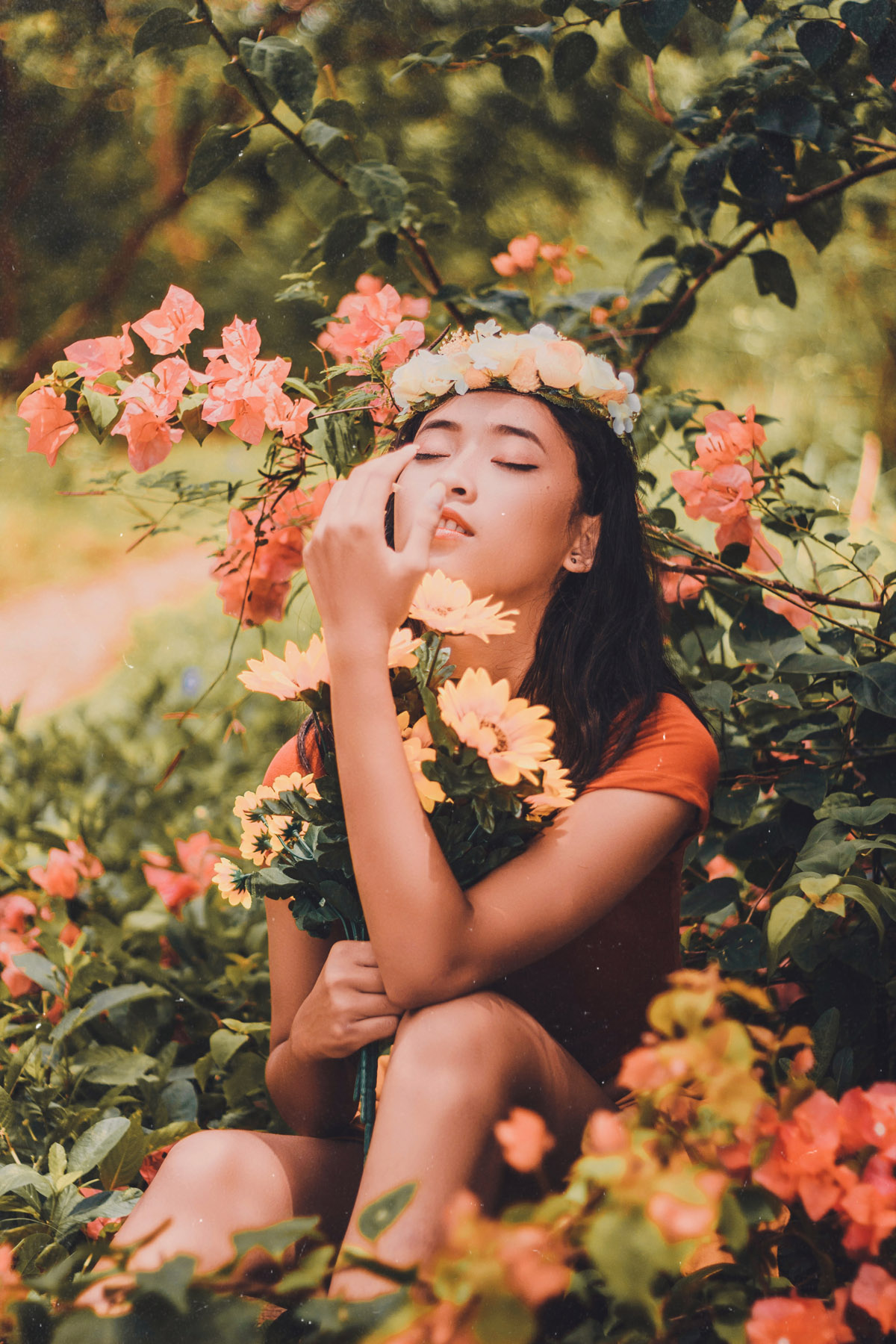

A few flowers in a jar can change the feeling of an entire room.
They do not reorganize the shelves, wash the dishes, or solve any of the problems waiting beyond the door. Yet their presence can make a space feel softer, livelier, and more carefully tended. We pause when we pass them. We notice when another bloom has opened. We lean closer to examine a color, pattern, or scent that did not exist in the room before.

Human beings have gathered, grown, exchanged, painted, pressed, worn, and arranged flowers for thousands of years. We bring them into celebrations and places of mourning. We place them on tables, altars, graves, windowsills, and bedside stands. We carry them to people when words feel insufficient.
Their importance cannot be explained by usefulness alone.
Flowers matter because they bring us into closer contact with life. They help us notice beauty while it is here, remember what has passed, mark what matters, and express what is sometimes difficult to say.
Flowers Bring a Living Presence Into the Home

We tend to connect most deeply with things that are alive.
Even when no words are spoken and no eye contact is made, the presence of another living being can give us the subtle sense that we are not entirely alone. A plant leaning toward a window, a cat asleep in a chair, or a vase of flowers slowly opening on a table brings a kind of quiet companionship into a space.
Flowers are still, but they are not static. They continue to drink, open, soften, turn toward the light, and change for as long as their conditions allow. Their presence reminds us that life does not always need to be productive or dramatic in order to be worth experiencing. Sometimes living is enough.

This kind of living contact may feel increasingly precious in a world filled with screens, artificial surfaces, manufactured images, and experiences designed to imitate the real thing. Flowers return texture, scent, irregularity, and natural change to the rooms in which we spend our days.
Cutting a flower shortens the life it might have lived in the garden. There is something bittersweet in that. Yet when we bring a bloom indoors, we give it another kind of life within human attention. It may be noticed each morning, admired by visitors, sketched, photographed, pressed, or remembered long after its petals have fallen.
We do not extend its biological life, but we extend its meaning.

Flowers also transform a room through their relationship with what is already there. They introduce movement among straight lines, color against quiet walls, fragrance into still air, and natural variation among repeated forms. A branch may soften an architectural corner. A handful of yellow flowers may awaken a dark wooden table. One unexpected stem can interrupt the ordinary pattern of a room.

In the wild, many blooms last only briefly. Bringing one inside ensures that, for a little while, its life does not pass entirely unnoticed.
Flowers Invite Us to Look More Closely

Flowers reward attention.
We may first notice a bloom because of its color, but closer looking reveals an entire small world: branching veins, speckled petals, translucent edges, folded centers, tiny hairs, and gradual changes from one shade to another.
Some flowers are built from five simple petals. Others hold dozens in tightly layered spirals. There are heart shapes, bells, stars, cups, soft ovals, ruffled edges, and structures so intricate that they seem almost architectural.

Leaves and petals often carry branching and repeating patterns similar to those found throughout the natural world. These shapes give the eye something complex but coherent to explore. For a moment, our attention narrows. We stop scanning the room or rehearsing what needs to be done next and become absorbed in one small mystery.
That attention can feel peaceful because it asks nothing from us except that we look.

Flowers remind us that beauty is often revealed through closer observation. What first appears to be one shade of pink may contain cream, coral, violet, and green. What seems symmetrical from across the room may be full of tiny variations up close.
We enter a world that is orderly without being rigid, detailed without feeling cluttered, and enchanting without needing to be invented.
Flowers Help Us Feel the Passage of Time

Flowers tell time in a language older than clocks.
Crocuses and daffodils announce that winter is beginning to loosen its hold. Lilacs belong to a particular stretch of spring. Peonies appear extravagantly and disappear almost as quickly. Roses, daylilies, sunflowers, asters, chrysanthemums, and dried seed heads carry us through the warmer months and toward autumn.
Because many flowers bloom for only a short period, they help divide the year into meaningful chapters.
We may remember a season not by its calendar dates but by what was flowering: the year the apple blossoms opened early, the week the lilacs filled the yard with scent, or the summer the roadside was covered with lupines.

Flowers also help us see time as cyclical rather than as a straight line leading only from beginning to end. A bloom fades, the plant rests, and under the right conditions it returns. Each season carries familiar rhythms, but no season is ever exactly the same. There are always new variations to notice, new conditions to respond to, and new lessons hidden within what appears to be a repetition.
The returning flowers remind us that fresh opportunities may arrive more often than we realize. Life contains many small beginnings: another spring, another morning, another attempt, another chance to tend something differently.

Even store-bought flowers reflect a kind of emotional seasonality. Although many varieties can now be found throughout the year, we still choose according to mood, celebration, curiosity, and atmosphere. Pale tulips may feel right in early spring. Loose garden roses may suit a summer table. Rust-colored chrysanthemums may belong beside an autumn meal.
Flowers help us experience time rather than merely measure it. They reveal the cycles moving within it: emergence, fullness, fading, rest, and return.
Their arrival teaches anticipation. Their brief fullness teaches appreciation. Their fading tells us when a moment is passing. Their return reminds us that an ending is not always the end of the story.
Flowers Hold Memory

Flowers can become containers for memory.
A particular scent may return us to a childhood garden before we have consciously identified it. A row of irises may remind us of a relative who grew them. A rose may recall a wedding, while carnations may bring back a funeral, a school ceremony, or a bouquet once received at an important moment.
These associations are often intensely personal. The same flower can mean celebration to one person and grief to another.
Flowers become woven into memory partly because they engage several senses at once. We remember not only how they looked, but how they smelled, how their petals felt, where they grew, who gathered them, and what was happening around us at the time.
Sometimes the memory belongs to an ordinary day. A pressed flower may preserve a walk taken alone. A dried bouquet may recall a season spent in a particular home. A plant divided from a grandmother’s garden may continue blooming decades after the original garden is gone.
Flowers give physical form to moments that might otherwise be difficult to hold.
Flowers Give Form to Feelings

Flowers often appear when emotion exceeds ordinary language.
We bring them to celebrate births, engagements, anniversaries, graduations, and new homes. We send them when someone is ill, grieving, lonely, or beginning again. They appear at apologies, welcomes, memorials, and partings.
Perhaps nowhere is this instinct more visible than at a wedding.

For a day devoted to love, commitment, hope, and the beginning of a shared life, people often surround themselves with as many flowers as circumstances allow. They are carried down the aisle, woven into arches, placed on tables, pinned to clothing, scattered by children, held during vows, and preserved afterward.
Flowers help distinguish the day from ordinary time. Their abundance creates the feeling that something precious is being witnessed and honored. Through color, fragrance, softness, and living beauty, they give visible form to love, celebration, and the hope of a life growing toward greater wholeness.
Flowers do not explain the feeling, but they make it present.
A bouquet says that someone was remembered. A stem left at a grave says that a relationship continues through memory. Flowers placed in a guest room say that someone’s arrival matters. A few blooms carried to a neighbor can express gratitude, sympathy, or affection without requiring an elaborate speech.
Different flowers can also carry different moods. A loose bunch of daisies may feel cheerful and familiar. White lilies can feel solemn. Red roses have become closely tied to romantic love. Forget-me-nots speak through their very name.
We use flowers because they offer a gentle language of color, scent, gesture, and presence. They help us honor feelings that are too large, tender, or complicated to contain in words alone.
Flowers Carry Symbolism, Story, and Lore

Flowers have never been merely decorative.
Across cultures and centuries, people have associated them with gods and saints, love and grief, protection and fertility, secrecy and remembrance. They appear in myths, religious traditions, folk remedies, paintings, poetry, heraldry, wedding customs, and burial rites.
The lotus has carried meanings of purity, creation, and spiritual emergence. Roses have been connected with love, secrecy, devotion, beauty, and mortality. Poppies have represented sleep, remembrance, and consolation. Violets have been associated with modesty and faithfulness. Daffodils often suggest renewal, while chrysanthemums may represent longevity, grief, celebration, or autumn depending on the culture in which they appear.

Flower meanings are not fixed or universal. Their symbolism changes across regions, eras, religions, families, and personal experience. That variation is part of their richness.
A flower can hold its botanical life, cultural story, and private meaning all at once.
When we choose flowers intentionally, we add another layer to the atmosphere of a home or gathering. The arrangement becomes more than a collection of pleasing colors. It can quietly honor a season, a person, a place, or an idea that matters to us.
Flowers Turn Ordinary Care Into Ritual

Ritual does not have to be formal or grand.
It can be the Saturday habit of visiting a farmers market and choosing one bundle of flowers. It can be cutting a few stems from the yard before guests arrive, changing the water in a vase each morning, or placing a single bloom beside the bed.
The action itself is small. Its meaning comes from repetition and attention.
Flowers often become part of ritual because they help us mark beauty, memory, grief, celebration, and seasonal change.

A vase on the kitchen table can become a quiet reminder that ordinary life is still meaningful. We give daily life meaning partly through how we perceive it, but also through what we choose to do. Arranging flowers, hanging artwork, setting out a passed-down bowl, lighting a candle, or thoughtfully composing a room are outward expressions of inward values.
They say that beauty matters here. Memory matters here. The atmosphere of everyday life is worth tending.
Flowers are especially suited to this kind of ritual because their care must be renewed. The water clouds. A stem droops. A petal falls. We trim, rearrange, remove, and begin again.
Through these small acts, attention becomes visible.
Flowers Teach Us to Value What Does Not Last

Flowers are beautiful partly because they are temporary.
They open, reach their fullness, soften, fade, and fall. We know from the beginning that we cannot keep them as they are.
Their briefness changes the way we look at them. We may pause because the peony will not be there next week. We take the photograph because the apple tree will soon lose its blossoms. We bring the lilacs inside because their season is already passing.
Flowers teach us that impermanence does not make something meaningless.
A meal ends. A season changes. Children grow. Homes are altered. Gatherings disperse. Much of what gives life its beauty cannot be held permanently.
Flowers do not ask us to preserve every moment. They ask us to be present for it.
Flowers Connect People, Gardens, and Generations

Flowers move between people.
They are carried as bouquets, exchanged as seeds, divided as roots, shared as cuttings, and passed down through gardens. A plant that began in one yard may eventually bloom beside several homes.
These exchanges carry more than plant material. They carry stories.
This rose came from a grandmother’s garden. These hollyhocks were grown from seeds collected beside an old farmhouse. These daffodils were divided when a friend moved away. This houseplant began as one cutting on someone else’s windowsill.
Through flowers, one person’s care can continue growing in another place.
They also connect us with the more-than-human life of a garden. Our appreciation for flowers encourages us to grow and protect them, and flowering plants in turn feed pollinators, form seeds, and continue into another generation.
Flowers create exchange between indoors and outdoors, past and present, person and place.
A Life With Flowers

We do not need flowers because they are efficient, practical, or permanent.
We need them because usefulness is not the only measure of a meaningful life.
Flowers bring living presence into our homes. They invite us to notice more closely, mark the seasons, hold memories, express care, and make our values visible. They connect us with stories older than ourselves and with people and gardens that may continue long after one bloom has faded.
We do not bring flowers inside because they last. We bring them in because they are alive now.
A few stems on a table cannot solve everything. But they can change the feeling of a room, preserve the memory of a season, and remind us to give our attention to the life directly in front of us.