
Some homes feel peaceful the moment you step inside. Some gardens make you want to wander slowly, even before you know why. A doorway can feel welcoming, a room can feel stiff, a path can feel magical, and one small detail can make an entire corner feel complete.
Often, this has less to do with expense and more to do with design.
The timeless principles of design help explain why certain spaces feel balanced, graceful, sturdy, lively, restful, or full of charm. These principles appear in homes, gardens, furniture, architecture, music, writing, speech, clothing, and nature itself. Once you begin to notice them, decorating becomes much more intuitive. You start to see why a room feels too harsh, why a garden bed feels unfinished, why a wall feels empty, or why one curved detail suddenly makes everything feel softer.
By the end of this article, you will have a new way to look at your home and garden. You will be able to notice why a room feels too boxy, why a corner feels unfinished, why a shelf feels cluttered, why a path feels inviting, or why one simple flower in a vase can feel so peaceful.
These principles are tools for seeing.

At Heart & Hearth, design is part of the art of living well. A home does more than hold our belongings. It shapes how we move, rest, gather, create, and recover from the noise of the outside world. When we learn to work with line, shape, balance, proportion, rhythm, and repose, we are really learning how to create spaces that support the way we want to feel and live.
A well-designed room gives the eye somewhere to go and the body somewhere to settle. It creates fewer contradictions for the nervous system to sort through. There is structure where we need support, softness where we need comfort, rhythm where we need movement, and breathing room where we need peace.
Let’s look at the timeless principles that can help you see your home and garden with new eyes.
1. Line and Shape: The Character of a Space

Line is one of the first ways we understand the essence of a thing.
Before we notice detail, color, texture, or ornament, we often recognize a form by its outline. A silhouette alone can tell us whether something is a chair, a tree, a pitcher, a house, a flower, or a person. This makes line powerful because it gives the first clue to character.
Straight lines tend to feel structured, active, orderly, purposeful, and strong. We see them in fences, beams, tables, bookshelves, window frames, raised beds, and the upright walls of a house.
Curved lines feel softer, gentler, more flowing, and more organic. We see them in arches, rounded cushions, garden paths, vines, scalloped edges, floral patterns, oval mirrors, curved chair backs, and the natural bend of stems and branches.
Traditionally, straight lines have often been associated with masculine qualities such as structure, direction, and strength, while curves have been associated with feminine qualities such as softness, flow, and receptivity. Whether or not we use those exact terms, most of us can feel the difference between a sharp, angular chair and a rounded one with soft arms.
A room filled with too many straight lines can feel harsh or boxy. A room with curves, softness, and flowing details tends to feel more inviting.
Think of the difference between a modern roofline with clean, straight edges and an older home with curved brackets, decorative trim, arched windows, scalloped porch details, or ornamental moulding. The older home often feels more charming because the eye has more to follow. The structure remains steady, but the ornament softens it.
The same idea applies to gardens. An English cottage garden often uses curving paths, overflowing borders, and soft, wandering lines that invite you to pause and explore. A French potager tends to feel more structured, with orderly beds, symmetry, and elegant geometry. Both can be beautiful, but they create different moods.

One encourages wandering, contemplation, and discovery. The other gives a sense of refinement, order, and intention.
Shape works in a similar way.
Squares and rectangles feel stable, practical, and grounded. They are the shapes of tables, chairs, doors, bookshelves, picture frames, walls, and raised beds.
Circles feel whole, soft, complete, and welcoming. Round mirrors, circular tables, curved lamps, oval rugs, wreaths, bowls, and rounded planters can soften a room that has too many hard edges.
Triangles feel directional and energetic. They can suggest movement, lift, balance, or tension. A triangular roofline, a tapered bouquet, a three-part mantel arrangement, or a garden trellis can all create this effect.

Arches are especially powerful because they combine strength with softness. They are architectural, but graceful. This is one reason arched doorways, arched mirrors, and arched garden entrances feel so timeless.
In the garden, shape matters just as much. Rectangular beds feel orderly and efficient. Circular beds create a sense of gathering or radiance. Curved beds feel natural and flowing. Triangular or wedge-shaped beds can direct attention or create movement.
The question is not only, “What shape fits here?” It is also, “What mood does this shape create?”
Look Around
What kinds of lines dominate your home? Are they mostly straight, curved, vertical, horizontal, or diagonal?
Does a room feel too boxy or harsh?
Could a curved mirror, rounded chair, arched shelf, scalloped edge, curtain, rug, or plant soften the space?
What shapes repeat most often in your home?
What shapes do you use for your garden beds?
Could you use shape more intentionally to create calm, charm, structure, elegance, playfulness, or softness?
2. Symmetry and Balance: Creating Calm and Steadiness

Symmetry gives the eye a sense of rest.
When both sides of an arrangement correspond, we feel order. This is why matching planters beside a front door, lamps on either side of a bed, paired chairs, centered artwork, and balanced windows often feel timeless.
Symmetry works beautifully when you want a space to feel formal, peaceful, settled, or dignified. It is especially effective at entrances because it creates a clear sense of welcome and intention.
In the garden, symmetry can make a path, gate, arbor, or potager feel elegant and composed. Two matching shrubs beside a walkway can frame an entrance. Four beds arranged around a central feature can create a sense of order and calm.

But perfect symmetry can sometimes feel stiff. A room that is entirely mirrored on both sides may start to feel staged. A garden with no irregularity may lose some of its life.
This is where balance becomes more useful than exact matching.
Balance is broader than symmetry. A space can feel balanced even when both sides are different. A large chair on one side of a room might be balanced by a smaller table, lamp, plant, and artwork on the other. The objects are not the same, but the visual weight feels steady.
A helpful phrase to remember is:
Even distribution does not have to mean equal distribution.

A room may need balance between straight and curved lines, light and dark colors, plain and ornate surfaces, soft and hard materials, empty and full areas, masculine and feminine qualities.
A heavy wooden table may feel more inviting with linen, flowers, candles, or delicate dishes. A floral sofa may need quieter pieces around it. A very boxy room may need curved furniture, textiles, plants, and ornament.
In the garden, balance might mean placing a large shrub on one side of a path and a looser grouping of perennials on the other. It might mean balancing a formal arbor with overflowing flowers. It might mean letting one side feel structured and the other more natural, as long as the whole still feels composed.
Look Around
Where do you already use symmetry in your home?
Do you have matching lamps, chairs, pillows, planters, or artwork?
Have you ever broken up perfect symmetry because it felt too formal or predictable?
Where does a room feel visually heavy?
Where does it feel empty or weak?
In your yard, where would symmetry feel beautiful?
Where would you rather let the planting feel looser and more natural?
3. Proportion, Scale, and Fitness: Making Things Feel Right

Proportion is about relationship.
An object may be beautiful by itself, but once it enters a room, it has to relate to everything around it. A mirror can be too small for a mantel. A rug can be too tiny for a room. A lamp can be too short for a table. A vase can be too small for the branches inside it.
This is why it helps to step back. When decorating, we often focus on the object in our hands. Proportion asks us to look at the whole.
A tall indoor tree might feel grand in a sunroom but overpowering in a small bathroom. A tiny painting may be lovely up close but feel lonely on a large wall. A small rug can make a room feel accidental, while a properly sized rug can make the furniture feel gathered and grounded.
In the garden, proportion matters between plant size, bed size, path width, house height, fence height, and the surrounding landscape.
Scale is closely related to proportion, but it has its own magic.
Proportion asks whether things relate well. Scale asks how size itself affects mood.

Large scale can create drama, grandeur, and confidence. A large painting, mural, mirror, branch arrangement, chandelier, or oversized planter can make a space feel intentional and memorable when used well.
Small scale can create intimacy, charm, and curiosity. Tiny animal figurines tucked into a plant pot, miniature framed art on a shelf, a small dish for rings, or a little garden statue partly hidden among herbs can invite someone to lean in and notice.
This is one of the sweetest ways to add personality to a home or garden. Large scale creates impact. Small scale creates discovery.
Fitness means suitability.
This principle matters because something can be beautiful and still be wrong for the situation. A delicate silk chair may be beautiful, but not fit a muddy entryway. A huge sectional may be comfortable, but not fit a small cottage room. A fragile white rug may not fit a home with pets, children, boots, and garden soil.

Fitness asks:
Does this suit the room?
Does it suit the person?
Does it suit the use?
Does it suit the mood?
Does it suit the life actually being lived here?
This is where design becomes practical and humane.
Look Around
Is the artwork large enough for the wall?
Is the rug large enough to gather the furniture?
Are the plants proportional to the bed, house, path, or container?
Where could you use something larger for more impact?
Where could you use something tiny for charm?
Does this item fit the way the space is actually used?
4. Repetition, Rhythm, and Movement: Leading the Eye

Repetition creates connection.
When a color, shape, material, pattern, or motif appears more than once, the space begins to feel intentional. Repeated brass accents, floral motifs, curved shapes, terracotta pots, linen textures, or botanical prints can quietly tie a room together.
Rhythm happens when repetition creates movement.
A row of stepping stones creates rhythm. So does a line of lavender, a series of arches, repeated beams across a ceiling, matching sconces down a hallway, or a floral pattern that travels across wallpaper.
Rhythm also appears in writing and speech. A repeated phrase, a mix of long and short sentences, or a well-paced paragraph can create movement for the reader. In music, rhythm is obvious. In decorating, it is quieter, but the effect is similar: it carries attention forward.
A room without repetition can feel scattered. A room with too much exact repetition can feel dull. The goal is repetition with gentle variation.
Movement can exist even when nothing is physically moving.

A curved path makes us wonder what is around the bend. A staircase draws the eye upward. A vine trails around a doorway. A branch in a vase lifts and bends. A diagonal line creates energy. A spiral suggests inward or outward motion.
Movement affects how a space feels. A straight hallway may encourage quick passage. A winding garden path invites slower wandering. A rounded seating area encourages lingering. A strong diagonal arrangement can make a mantel or shelf feel more dynamic.
This principle is especially useful in gardens. Paths, borders, vines, plant heights, arches, and focal points all guide movement. They tell the body where to go and the eye where to look.

Inside the home, movement can be created with lines, repeated shapes, fabric folds, lighting, artwork, and furniture placement.
There is also something beautiful in the older phrase composition of line. It suggests that one line flows into another. A curved path leads toward a gate. A vine trails around a doorway. A chair back echoes the curve of a mirror. A curtain falls in vertical folds that continue the height of the window. A branch arrangement lifts the eye upward, then bends gently outward.
This is why some spaces feel graceful. Their lines are not random. They speak to each other.
Look Around
What repeats in your home?
Do you repeat a material, such as wood, brass, wicker, linen, or ceramic?
Do you repeat a shape, such as arches, circles, florals, or clean straight lines?
Where does your eye naturally travel in a room?
Does your garden invite exploration?
Could a curved path, archway, vine, or repeated planting create more movement?
5. Contrast and Variety: Bringing a Space to Life

Contrast creates interest through difference.
Straight and curved. Light and dark. Rough and smooth. Old and new. Plain and ornate. Soft and hard. Large and small. Matte and glossy.
Contrast helps each quality become more visible. A rough wooden table looks more beautiful with linen and flowers. A plain wall becomes more interesting with ornate trim. A boxy room becomes softer with rounded furniture. A delicate floral pattern can feel stronger beside dark wood or iron.
Variety keeps a space from feeling monotonous. A room with only one texture, one height, one shape, or one material may feel flat. But variety needs some kind of order, or it becomes visual noise.

The best variety usually happens within a shared mood.
For a Heart & Hearth kind of home, variety might include aged wood, linen, pottery, wicker, flowers, botanical prints, warm lighting, soft rugs, and a few meaningful old objects. These things are different, but they can still feel like they belong together.
Contrast is also useful in the garden. Soft flowers look even softer beside stone. Delicate foliage becomes more noticeable beside broad leaves. A rustic fence can make roses feel more romantic. A formal path can make overflowing plants feel even more abundant.

Look Around
Does this room have enough contrast?
Is there a balance of rough and smooth, soft and hard, plain and detailed?
Does the variety feel collected or chaotic?
What shared mood, color, material, or story holds the room together?
Could your garden use more contrast in leaf shape, height, color, texture, or structure?
6. Emphasis, Hierarchy, and Subordination: Giving the Eye a Place to Rest

Every space benefits from a main moment.
In a living room, it might be the fireplace. In a bedroom, the bed. In an entryway, the front door or a beautiful mirror. In a garden, it might be an arbor, fountain, bench, gate, tree, or central bed.
Emphasis tells the eye where to land first.
Hierarchy tells the eye what to notice next.
Without emphasis, a room can feel confusing because everything asks for equal attention. With too many focal points, the space can feel restless. When hierarchy is clear, the eye moves naturally: first to the main feature, then to supporting details, then to smaller discoveries.

Subordination is part of this. Once one element leads, the others support it. If wallpaper is dramatic, furniture may need to be quieter. If a fireplace is the focal point, nearby decor should frame it rather than fight it. If a flower arrangement is the star of a table, the dishes and linens can support the mood.
Subordination does not mean the supporting details are unimportant. It means they know their role. This creates peace because the eye does not have to decide what matters most.
Look Around
What is the main focal point in this room?
Does anything compete with it?
What should the eye notice second?
Are the smaller details supporting the main feeling?
Does your garden have a focal point or a place the eye wants to arrive?
7. Unity, Order, and Geometrical Arrangement: Making Everything Belong

Unity is the feeling that everything belongs.
A unified room does not need to be perfectly matched. In fact, collected homes often feel more soulful than rooms where every item came from the same set. Unity comes from shared color, material, shape, mood, era, purpose, or story.
Order helps the eye understand what it sees.
A layered cottage room can still have order. A full garden can still have order. A shelf filled with meaningful objects can still feel composed. Order comes from grouping, repetition, proportion, hierarchy, and rhythm.
Without order, abundance becomes clutter. With order, abundance becomes richness.
This is especially important for people who love beauty, plants, books, flowers, crafts, collections, and seasonal decor. You do not have to strip everything away to create peace. You can create order through relationship.

Geometrical arrangement gives hidden structure.
Rooms, gardens, furniture layouts, tile patterns, windows, panels, rugs, and artwork often feel more satisfying when there is an underlying geometry. A circular table under a round light fixture, a rectangular rug grounding a seating area, a triangular mantel arrangement, or a garden bed arranged around a central point all use geometry.
This structure does not have to feel rigid. In traditional design, geometry often works quietly beneath the surface. It gives beauty a kind of inner order.
Look Around
What makes the room feel unified?
Do the colors, materials, shapes, or themes relate to each other?
Where does the room feel cluttered because there is no clear grouping?
Could repetition, spacing, or hierarchy make the same objects feel more intentional?
Does your garden have a sense of order, even if it is abundant?
Is there an underlying shape or geometry holding the design together?
8. Repose, Stability, and Breathing Room: Helping the Home Feel Grounded

Repose is the feeling of rest.
A room with repose allows the body and mind to settle. It may have soft colors, gentle light, comfortable seating, symmetry, warm textures, and enough breathing room.
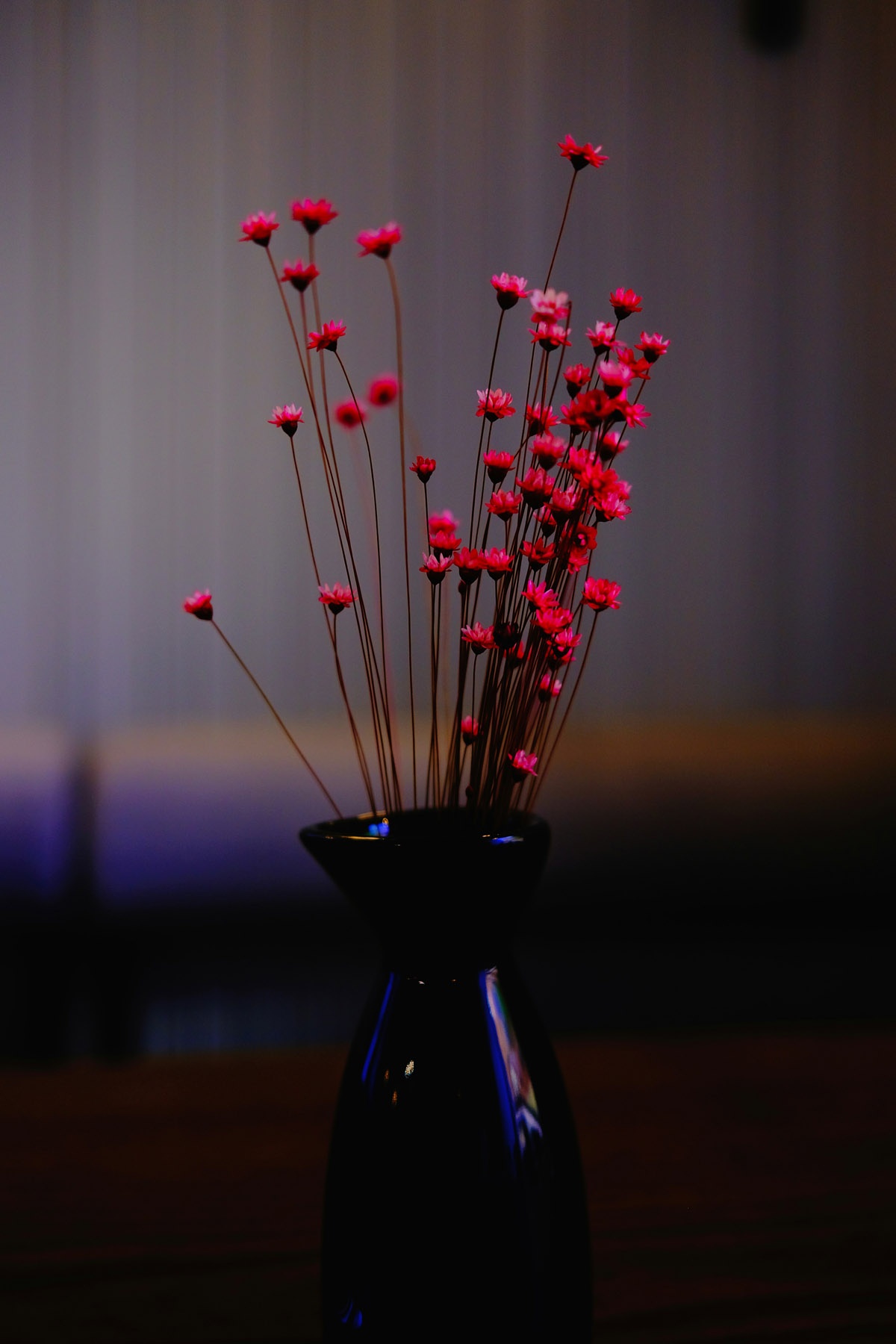
Repose can also be found in the simplest arrangement: a single delicate flower or branch in a vase, placed against a quiet monochrome wall. The plain background gives the eye room to rest, while the living form of the plant adds just enough movement, softness, and beauty. Nothing competes. Nothing feels crowded. The effect is calm, graceful, and contemplative.
Sometimes this kind of simplicity can feel more peaceful than a table full of decoration. The empty space around the flower allows the form to be fully seen: the curve of the stem, the softness of the petals, the small gesture of life.

Stability gives a sense of support and safety. It comes from strong horizontal lines, grounded furniture, sturdy materials, visual weight placed low in the room, and architecture that feels well-framed.
This is why fences, walls, beams, tables, hearths, and solid cabinets can feel reassuring. They hold the space.
Curves and softness are comforting, but structure matters too. A home needs both. The straight lines of a fence tell us the boundary is held. The upright walls tell us the house will stand. The rounded arms of a chair tell us the body can rest.
Together, stability and repose make a home feel safe, calm, and nourishing.
Look Around
Where does your home feel restful?
Where does it feel unsettled?
Do you have enough grounding pieces, such as sturdy furniture, rugs, cabinets, or low visual weight?
Do you have enough softness, such as textiles, curves, warm lighting, and plants?
Where could you create more breathing room?
What would help your nervous system relax in this space?
9. Growth, Radiance, and Ornament: Adding Soul

Some of the most beautiful design principles are also the most life-giving.
Growth appears in vines, branches, flowers, spirals, leaves, botanical wallpaper, carved ornament, and garden borders that seem to unfold. It brings vitality and renewal into the home.
Radiance appears when forms move outward from a center. A sunburst mirror, wreath, chandelier, ceiling medallion, round table, flower head, fountain, or fireplace can all create a radiating feeling.
Ornament adds meaning, softness, and soul. A plain doorway becomes more special with trim. A shelf gains charm with corbels. A ceiling feels more complete with crown moulding. A cabinet becomes more personal with beautiful hardware, carved detail, or a painted motif.

Older homes often feel charming because they include these humanizing details. The eye can pause. The hand of craft is visible. There is something to notice beyond plain utility.
Many modern spaces have the opposite problem: too much flatness, too many hard edges, too little symbolism, softness, or delight.
Ornament can be subtle. It might be a curved bracket beneath a shelf, a floral stencil around a doorway, a carved wooden frame, a scalloped lampshade, a vintage drawer pull, or crown moulding that softens the hard meeting point between wall and ceiling.
These details make a home feel cared for. They remind us that usefulness and beauty can live together.
Look Around
Where could your home use more life?
Could you add botanical pattern, flowers, vines, branches, or plant forms?
Where could a small ornament make something plain feel more loved?
Could crown moulding, trim, corbels, brackets, scalloped edges, or decorative hardware soften a harsh area?
Where does your home radiate warmth?
How to Use These Principles in Your Own Home

You do not have to apply every principle at once. Start with one room, one shelf, one doorway, one garden bed, or one small corner.
Try this simple process:
- Choose one area.
A mantel, entryway, bedside table, garden path, porch, or blank wall is enough. - Notice the dominant lines and shapes.
Are they straight, curved, sharp, soft, square, round, tall, low, formal, or flowing? - Ask what the space currently feels like.
Harsh? Empty? Crowded? Peaceful? Stiff? Playful? Heavy? Unfinished? - Decide what feeling you want more of.
Softness, structure, rhythm, contrast, repose, charm, elegance, warmth, or order? - Add the missing quality.
A curved mirror can soften. A larger picture can improve proportion. A repeated material can create unity. A plant can add growth. A clear focal point can create emphasis. A little empty space can create repose. - Step back and look at the whole relationship.
Design is relational. The object, the wall, the furniture, the light, the path, the plants, and the empty space all affect one another.
This is how you begin to see like a designer. You are not simply asking, “Do I like this object?” You are asking, “What is this doing in the space?”
Bringing It All Together

Once you begin to notice these principles, ordinary rooms become easier to read.
A harsh room may need curves, softness, texture, or ornament.
A scattered room may need repetition and order.
An empty wall may need better proportion or a stronger focal point.
A stiff garden may need movement and growth.
A chaotic shelf may need hierarchy and breathing room.
A plain doorway may need detail, framing, or flowers.
A space that feels almost right may simply need one balancing element.
The beauty of these principles is that they train the eye. They help you understand why something feels beautiful, awkward, peaceful, charming, formal, playful, sturdy, or alive.
Begin with one room, one corner, one garden bed, one doorway, or one shelf. Look at the lines. Notice the shapes. Step back and consider proportion. Ask where the eye travels. Decide what should be emphasized. Add softness where there is too much harshness. Add structure where things feel too loose. Repeat something. Remove something. Let one detail become more meaningful.
Over time, decorating becomes less about copying a finished look and more about learning how beauty works.
And once you learn to see it, you start noticing it everywhere: in the curve of a flower stem, the rhythm of a path, the balance of a mantel, the shape of a chair, the outline of a roof, the pacing of a sentence, and the quiet feeling of a home that welcomes you back into yourself.