“There’s no place like home.”
— Dorothy, The Wizard of Oz
In the last article, How to Create a Welcoming Home Through Beautiful Transition Spaces, we explored the meaning and significance of thresholds and how to create points of transition within and around the home that beckon us forward and signal safety to the nervous system.
Today, we are focusing on perhaps the most distinguished threshold of all: the front door.

The front door offers one of the greatest opportunities for cultivating a positive first impression, both for guests and for our own subconscious. The feeling we experience while approaching a front door quietly shapes what the mind and nervous system begin to expect upon entry.
In this sense, the doorway becomes an emotional crossing point.
It stands between the changing weather and busyness of the outer world and the nurturing sanctuary that awaits within.
For me, there is always a subtle shift that I can sense when I walk through my front door. After work, it signals that it is finally time to relax and return to the activities that matter most to me. After hours spent working beneath the hot summer sun, it signals refreshment and relief. After running errands on a cold winter day, it signals warmth, stillness, and restoration. Whatever the day’s circumstances, I know when I step across the threshold, I can breath.
A front door prepares us emotionally for the experience of entering.
It is an opportunity to communicate welcome, care, warmth, and invitation long before a single word is spoken.
Ways to Create a Welcoming Front Door
1. Keep the Area Clear, Tidy, and Cared For

Often, what is absent from a space matters just as much as what is present.
Conveniently, this is also one of the simplest and least expensive ways to transform the feeling of an entrance.
Clutter, broken items, overflowing trash, dead plants, harsh lighting, peeling paint, and signs of neglect can subtly create tension before one ever steps inside. Meanwhile, a swept porch, clean glass panes, healthy greenery, and functioning lighting instantly refresh the atmosphere of an entrance.
A quick sweep of the steps takes only moments. Replacing a burnt-out bulb, removing cobwebs, refreshing cracked paint, or clearing away unnecessary clutter can dramatically soften the emotional tone of a space.
Traditional feng shui often emphasizes keeping entrances clear and cared for so that energy may flow more harmoniously into the home. While I am far from a feng shui expert, I have always appreciated the way it encourages us to think intentionally about how spaces feel upon entering them.
2. Use Lighting to Create Warmth and Reassurance

Lighting has an immediate effect upon the nervous system.
Cold, harsh lighting can make an entrance feel sterile or overly exposed, while warm lighting softens the transition and creates emotional reassurance. A softly illuminated porch or pathway quietly signals that life, warmth, and care await within.
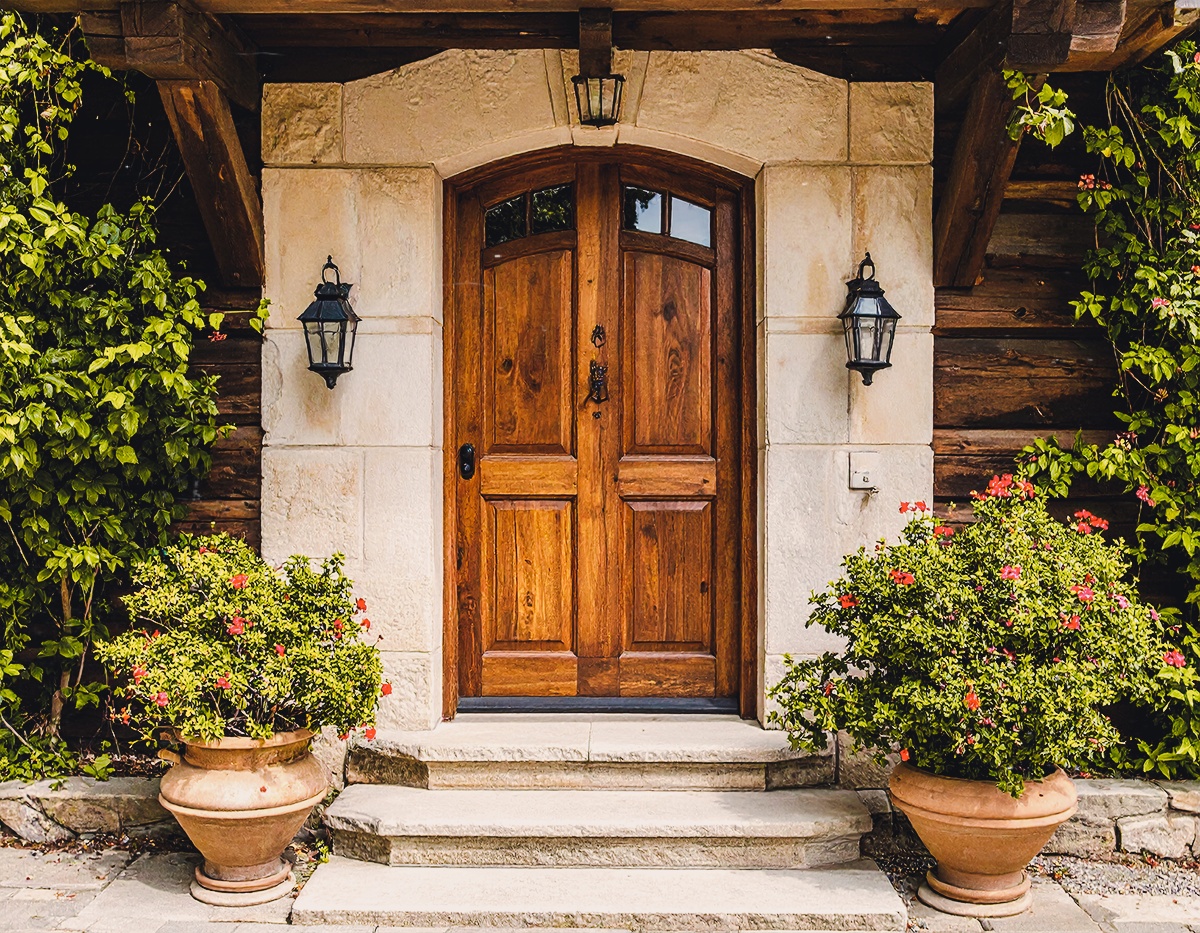
Few things feel more inviting than the golden glow of lantern light against greenery at dusk.
Wall sconces, lanterns, candles, string lights, and softly illuminated pathways all help create atmosphere while also improving visibility and safety. Layered lighting tends to feel especially welcoming because it creates depth and softness rather than flooding the space with brightness from a single harsh source.
Lighting also changes how a home is experienced seasonally. During winter especially, warm porch lighting can feel deeply restorative after returning home through darkness and cold.
Ideas to try:
- Warm porch lanterns
- Wall sconces beside the door
- Solar pathway lights
- Candle lanterns on the steps
- Outdoor string lights around a porch railing
- Warm bulbs instead of cool white bulbs
3. Add Wreaths, Greenery, and Seasonal Life

Living plants bring movement, softness, vitality, and a feeling of gentle abundance to an entrance.
Trailing ivy spilling from urns, lavender beside the steps, herbs near the doorway, climbing roses arching overhead — these details soften the transition between outdoors and indoors while making the entrance feel alive and attended to.
Seasonal wreaths can also become a beautiful ritual marking the changing seasons. A handmade wreath communicates intentionality and care in a way that mass-produced decor often cannot. Even simple seasonal touches — dried flowers in autumn, evergreen branches in winter, or fresh herbs in summer — create a sense of rhythm and connection to the natural world.
Traditional feng shui also places strong emphasis upon healthy living plants at entrances, associating them with vitality and healthy energy. Regardless of one’s beliefs about feng shui itself, there is something undeniably uplifting about approaching a doorway framed by healthy greenery and signs of life.
Ideas to try:
- A seasonal wreath on the door
- Matching urns on either side of the entrance
- Lavender, rosemary, or herbs in pots
- Climbing roses or clematis near an arbor
- Ferns for a shady entrance
- Trailing ivy, sweet potato vine, or creeping Jenny in planters
- Evergreen branches in winter
4. Choose a Doormat That Feels Practical and Personal

A doormat is one of the smallest details at the entrance, but it still plays an important role.
It helps protect the home from dirt, mud, and snow, while also creating a visual pause at the point of entry. It is the literal place where one stands before crossing the threshold.
A plain mat can be perfectly fine, but a thoughtfully chosen one adds warmth, personality, and charm. A layered doormat arrangement can also make the entrance feel more styled and intentional.
For example, a durable coir mat layered over a patterned outdoor rug can create a cozy, welcoming effect while still being practical.
Ideas to try:
- A simple coir doormat
- A seasonal doormat
- A layered mat and outdoor rug combination
- A floral or vintage-inspired outdoor rug beneath the mat
- A personalized doormat, used tastefully
- A boot tray nearby for rainy or snowy days
5. Add Seating as an Invitation to Pause

A chair beside the doorway communicates something quietly powerful: you are welcome to linger here.
A small bistro table prepared for tea, a rocking chair with a folded blanket, or a bench beneath climbing vines creates a pause within the transition itself. It allows the mind and body to settle before crossing further inward.
Even the smallest seating arrangement changes the emotional tone of an entrance. It transforms a purely functional threshold into a place of rest, conversation, and presence.
This can be especially beautiful on a porch, but even a modest front step can hold a small stool, garden chair, or simple bench if space allows.
Ideas to try:
- A wooden bench beside the door
- A small bistro table and chair
- A rocking chair on the porch
- A garden stool with a potted plant
- A folded blanket over a chair
- A small outdoor rug beneath seating
6. Use Sound, Scent, and Movement to Create Atmosphere

Atmosphere is experienced through more than sight.
The soft sound of wind chimes, birdsong, moving water, rustling grasses, or gravel beneath one’s feet can deeply influence how an entrance feels. These details engage the senses and make the experience of approaching home feel more immersive.

Scent can also shape memory and mood. Lavender, rosemary, jasmine, mint, thyme, and other fragrant plants near a doorway can subtly influence the emotional experience of entering a home.

A small fountain, a planter of herbs, a wind chime, or tall grasses moving in the breeze can bring a sense of life and gentle motion to the front entrance.
The key is subtlety. The entrance should feel alive and sensory without becoming overwhelming.
Ideas to try:
- Lavender or rosemary near the front door
- A small fountain by the entrance
- Wind chimes with a soft tone
- A cute rain chain
- Tall grasses in planters
- Fragrant flowers near seating
- Gravel or stepping stones for sound underfoot
- Citronella candles for summer evenings
7. Pay Attention to Texture, Material, and Craftsmanship

Often, the most welcoming entrances are the ones that feel personal and well considered.
The weight of a wooden front door.
An ornate antique handle cool beneath the hand.
Hand-painted trim surrounding the doorway.
A vintage hinge weathered beautifully with time.
Stone steps softened by potted flowers.
A handmade wreath changing with the seasons.
These details carry signs of craftsmanship, care, and human touch. They remind us that a home is cultivated over time.
In a world increasingly dominated by synthetic materials and mass production, thoughtful craftsmanship often feels deeply comforting because it reflects patience, intentionality, and personality.
You do not need a historic house or expensive materials to create this effect. Even small upgrades can make the entrance feel more personal: a better door knocker, prettier house numbers, a handmade wreath, a painted door, a brass handle, or a simple stencil around the doorframe.
Ideas to try:
- Vintage-inspired door hardware
- Brass or iron house numbers
- A painted front door
- Decorative hinges
- A handmade wreath
- Stenciled trim around the door
- Natural wood, stone, terracotta, wicker, or aged metal
8. Create Balance Without Making It Feel Stiff
A welcoming front door often feels balanced, but that does not mean everything needs to be perfectly symmetrical.
Symmetry can be beautiful at an entrance because it creates a sense of stability and order. Matching urns, sconces, or topiaries can make a doorway feel elegant and grounded.
But too much perfection can sometimes feel stiff.
A more natural approach is to create visual balance through repeated materials, related colors, and thoughtful distribution. For example, one large planter on one side might be balanced by a bench, lantern, or climbing plant on the other.

This is where design begins to feel more like composition. Repetition, contrast, texture, and proportion all work together to create harmony.
Ideas to try:
- Matching planters on either side of the door
- One large planter balanced by a bench
- Repeating brass, black iron, terracotta, or wood tones
- Similar flower colors repeated in the wreath and planters
- A doormat that echoes the color of the door or trim
- Soft curves to balance straight architectural lines
9. Let the Entrance Reflect the Season
A front entrance is one of the easiest places to honor the changing seasons.
You do not need to completely redecorate. A few subtle changes can shift the feeling of the entire threshold.

In spring, fresh flowers, pastel blooms, mossy textures, and young greenery can make the entrance feel renewed.
In summer, herbs, hanging baskets, porch seating, and lanterns create a sense of abundance and ease.
In autumn, dried flowers, pumpkins, warm-toned wreaths, and amber lantern light can make the home feel cozy and grounded.
In winter, evergreen branches, simple ribbons, warm lighting, and natural textures bring life and welcome into a darker season.
Seasonal changes keep the entrance feeling alive.
Ideas to try:
- Spring wreath with flowers or herbs
- Summer planters with trailing greenery
- Autumn dried flower wreath
- Winter evergreen urns
- Seasonal ribbon on a wreath
- Changing doormats or porch textiles with the season
10. Add One Personal Detail
The most memorable entrances usually have something personal.
An ornamental door-knocker. small statue. A handmade wreath. A painted door. A meaningful plant. A vintage bell. A family name sign. A planter you found secondhand and brought back to life.

These details make an entrance feel less like a staged image and more like a real home.
This is also where you can let your own style quietly speak. Cottage, French country, woodland, farmhouse, Victorian, Art Nouveau-inspired, simple and rustic — the front door can offer the first hint of the story inside.
A welcoming entrance isn’t created by spending more money on decorating the area alone, but rather, it’s the care we put into it and is felt by guests and ourselves as we walk up to it.
Ideas to try:
- A handmade wreath
- A small garden statue
- A meaningful potted plant
- Vintage hardware
- A painted house number sign
- A thrifted planter
- A door color you truly love
Final Reflection
Perhaps this is why thoughtfully designed entrances affect us so deeply.
They soften transitions, encourage presence, and quietly reassure us that warmth, beauty, and care await on the other side.
A welcoming front door does not have to be grand. It can be simple, humble, and deeply personal.
A swept step.
A warm light.
A healthy plant.
A wreath made with care.
A doormat beneath the feet.
A place to pause before entering.
Together, these small details help shape the emotional experience of coming home.
A welcoming front door is seen, crossed, touched, and felt.
